KI-Beratung Beta

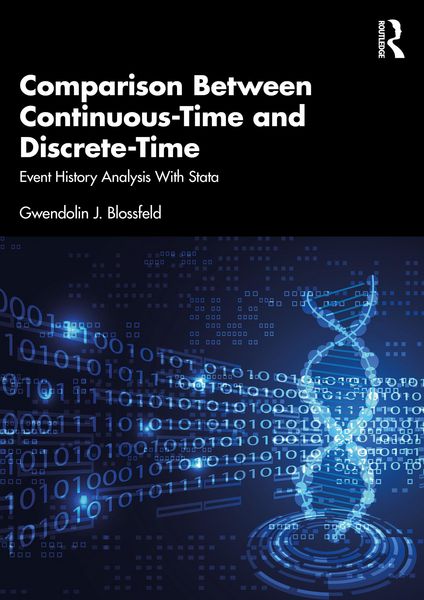
Produktbild: Comparison Between Continuous-Time and Discrete-Time

Comparison Between Continuous-Time and Discrete-Time Event History Analysis with Stata

Fr. 90.90

inkl. gesetzl. MwSt.

Beschreibung

Comparison Between Continuous-Time and Discrete-Time: Event History Analysis with Stata elucidates the statistical concepts and empirical applications of both continuous-time and discrete-time event history models. Empirical scientists have increasingly collected data on the timing of events, with the...

Beschreibung

Comparison Between Continuous-Time and Discrete-Time: Event History Analysis with Stata elucidates the statistical concepts and empirical applications of both continuous-time and discrete-time event history models. Empirical scientists have increasingly collected data on the timing of events, with the understanding that events can occur at any point in time and may be recorded using different observation schemes. However, time-continuous processes are not always observed with fine-grained temporal resolution; in some cases, they are captured with larger observation intervals (monthly, yearly, biennially, and quadrennially).

This book introduces the need for discrete-time event history analysis methods and adeptly discusses the limitations of the discrete-time approach when compared to continuous-time models. It offers an in-depth comparison of both methods and sheds light on how they differ and align. By utilizing the statistical software Stata and using a campus example data set, the book provides practical examples that showcase the implications of larger observation intervals in discrete-time applications.

This book serves as an essential resource for researchers, students, and practitioners seeking to comprehend the nuances of event history analysis in both continuous and discrete-time frameworks. Its comprehensive exploration of statistical techniques and real-world applications will equip readers with a deeper understanding of the strengths and limitations of each method, thus enabling more informed and robust decision-making in empirical research.

Produktdetails

Format

PDF

Kopierschutz

Ja

Family Sharing

Nein

Text-to-Speech

Nein

Produktdetails

Format

PDF

Format

eBooks im PDF-Format haben eine festgelegte Seitengröße und eignen sich daher nur bedingt zum Lesen auf einem tolino eReader oder Smartphone. Für den vollen Lesegenuss empfehlen wir Ihnen bei PDF-eBooks die Verwendung eines Tablets oder Computers.

Kopierschutz

Ja

Kopierschutz

Zum Lesen dieses eBooks auf Geräten der tolino Familie sowie auf sonstigen eReadern und am PC benötigen Sie eine Adobe ID. Weitere Hinweise zum Lesen von kopiergeschützten eBooks finden Sie unter Hilfe/Downloads.

Family Sharing

Nein

Family Sharing

Mit Family Sharing können Sie eBooks innerhalb Ihrer Familie (max. sechs Mitglieder im gleichen Haushalt) teilen. Sie entscheiden selbst, welches Buch Sie mit welchem Familienmitglied teilen möchten. Auch das parallele Lesen durch verschiedene Familienmitglieder ist durch Family Sharing möglich. Um eBooks zu teilen oder geteilt zu bekommen, muss jedes Familienmitglied ein Konto bei Thalia oder einem anderen tolino-Buchhändler haben. Weitere Informationen finden Sie unter Hilfe/Family-Sharing.

Text-to-Speech

Nein

Text-to-Speech

Bedeutet Ihnen Stimme mehr als Text? Mit der Funktion Text-to-Speech können Sie sich im tolino webReader und in der aktuellen Thalia – Lesen & Hören App das eBook vorlesen lassen. Weitere Informationen finden Sie unter Hilfe/Text-to-Speech.

Erscheinungsdatum

30.09.2025

Verlag Taylor & Francis eBooks
Seitenzahl

160 (Printausgabe)

Dateigröße

16091 KB

Auflage

1. Auflage

Sprache

Englisch

EAN

9781040385494

Barrierefreiheit
  • keine Vorlesefunktionen des Lesesystems deaktiviert

Noch keine Bewertungen vorhanden

Verfassen Sie die erste Bewertung zu diesem Artikel

Helfen Sie anderen Kundinnen und Kunden durch Ihre Meinung.

Kundinnen und Kunden meinen

Bewertungen (0)

Weitere Artikel finden Sie in

Die Leseprobe wird geladen.
  • Produktbild: Comparison Between Continuous-Time and Discrete-Time