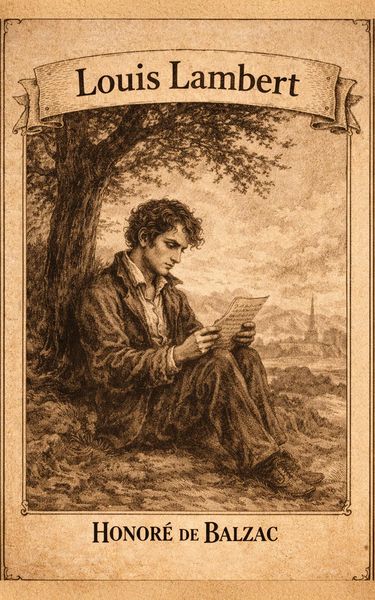
Louis Lambert
-
- Hardcover
- Taschenbuch
- eBook ausgewählt
-
Form:Einzelkauf Download
-
Sprache:Englisch
- Englisch ausgewählt
- Französisch Fr. 1.00
-
eBook Format:ePUB 3
- PDF Fr. 3.90
- ePUB 3 ausgewählt
- ePUB Fr. 1.00
Fr. 0.50
inkl. gesetzl. MwSt.Beschreibung
Produktdetails
Format
ePUB 3
Kopierschutz
Nein
Family Sharing
Ja
Text-to-Speech
Ja
Erscheinungsdatum
18.02.2026
Verlag
CLXBXSeitenzahl
139 (Printausgabe)
Dateigröße
649 KB
Sprache
Englisch
EAN
9780435406424
Louis Lambert is one of Honoré de Balzac's most profound and philosophical works, a deeply introspective novel that explores genius, spirituality, madness, and the limits of human understanding. First published in 1832 as part of La Comédie Humaine, this remarkable narrative stands apart from Balzac's more socially driven novels, offering instead a penetrating examination of the inner life of an extraordinary mind.
The story follows the life of Louis Lambert, a brilliant and intensely imaginative young man whose intellectual gifts set him apart from his peers from an early age. Raised in a modest provincial environment, Louis quickly reveals a prodigious talent for abstract thought and philosophical reflection. Recognized for his brilliance, he is sent to the Collège de Vendôme, where he forms a close friendship with the narrator. Through this narrator's recollections, we witness Louis's intellectual development, his mystical speculations, and his growing detachment from the ordinary world.
Deeply influenced by the mystical philosophy of Emanuel Swedenborg, Louis becomes absorbed in metaphysical questions concerning the soul, willpower, spiritual energy, and the relationship between matter and spirit. He attempts to formulate a grand philosophical system-his "Treatise on the Will"-which seeks to explain the hidden forces governing existence. However, his relentless pursuit of absolute knowledge comes at a cost. As his thoughts grow increasingly abstract and visionary, he begins to withdraw from society, drifting toward isolation and mental collapse.
Balzac masterfully portrays the tragic tension between genius and fragility. Louis Lambert is not simply a story about intellectual brilliance; it is a meditation on the dangers of unrestrained thought and the fine line between inspiration and madness. Through Louis's life, Balzac examines the burden of exceptional intelligence in a world that neither fully understands nor supports it. The novel raises enduring questions: Can the human mind safely explore the infinite? Is spiritual enlightenment compatible with earthly existence? What happens when imagination outpaces reality?
Unlike many of Balzac's novels that dissect French society, Louis Lambert is intimate and philosophical. It draws heavily from Balzac's own youthful experiences and intellectual struggles, making it one of his most personal works. The novel blends realism with mysticism, biography with speculation, and narrative with philosophical discourse. It offers readers not just a story, but an exploration of consciousness itself.
Poetic, reflective, and deeply psychological, Louis Lambert stands as a powerful portrait of a misunderstood genius whose quest for ultimate truth leads him beyond the boundaries of reason. It remains a compelling work for readers interested in philosophy, psychology, spirituality, and the enduring mystery of the human mind.
A timeless exploration of intellect and transcendence, Louis Lambert invites readers into the extraordinary inner world of a man who dared to think beyond the limits of his time.
The story follows the life of Louis Lambert, a brilliant and intensely imaginative young man whose intellectual gifts set him apart from his peers from an early age. Raised in a modest provincial environment, Louis quickly reveals a prodigious talent for abstract thought and philosophical reflection. Recognized for his brilliance, he is sent to the Collège de Vendôme, where he forms a close friendship with the narrator. Through this narrator's recollections, we witness Louis's intellectual development, his mystical speculations, and his growing detachment from the ordinary world.
Deeply influenced by the mystical philosophy of Emanuel Swedenborg, Louis becomes absorbed in metaphysical questions concerning the soul, willpower, spiritual energy, and the relationship between matter and spirit. He attempts to formulate a grand philosophical system-his "Treatise on the Will"-which seeks to explain the hidden forces governing existence. However, his relentless pursuit of absolute knowledge comes at a cost. As his thoughts grow increasingly abstract and visionary, he begins to withdraw from society, drifting toward isolation and mental collapse.
Balzac masterfully portrays the tragic tension between genius and fragility. Louis Lambert is not simply a story about intellectual brilliance; it is a meditation on the dangers of unrestrained thought and the fine line between inspiration and madness. Through Louis's life, Balzac examines the burden of exceptional intelligence in a world that neither fully understands nor supports it. The novel raises enduring questions: Can the human mind safely explore the infinite? Is spiritual enlightenment compatible with earthly existence? What happens when imagination outpaces reality?
Unlike many of Balzac's novels that dissect French society, Louis Lambert is intimate and philosophical. It draws heavily from Balzac's own youthful experiences and intellectual struggles, making it one of his most personal works. The novel blends realism with mysticism, biography with speculation, and narrative with philosophical discourse. It offers readers not just a story, but an exploration of consciousness itself.
Poetic, reflective, and deeply psychological, Louis Lambert stands as a powerful portrait of a misunderstood genius whose quest for ultimate truth leads him beyond the boundaries of reason. It remains a compelling work for readers interested in philosophy, psychology, spirituality, and the enduring mystery of the human mind.
A timeless exploration of intellect and transcendence, Louis Lambert invites readers into the extraordinary inner world of a man who dared to think beyond the limits of his time.
Noch keine Bewertungen vorhanden
Verfassen Sie die erste Bewertung zu diesem Artikel
Helfen Sie anderen Kundinnen und Kunden durch Ihre Meinung.