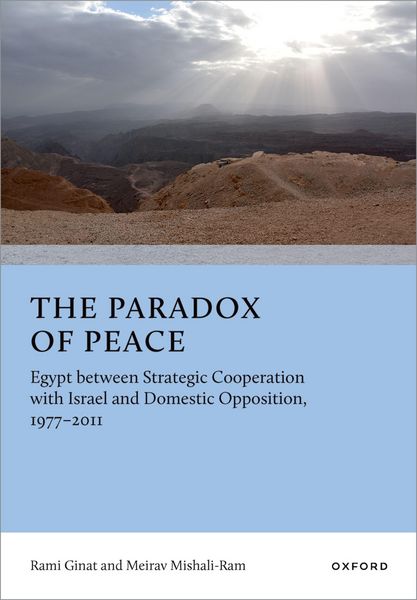
The Paradox of Peace Egypt Between Strategic Cooperation with Israel and Domestic Opposition, 1977-2011
-
- Englisch ausgewählt
Fr. 152.00
inkl. gesetzl. MwSt.,
Beschreibung
Produktdetails
Einband
Gebundene Ausgabe
Erscheinungsdatum
23.10.2026
Verlag
Oxford University PressSeitenzahl
304
Maße (L/B)
25.4/17.8 cm
Sprache
Englisch
ISBN
978-0-19-785964-3
The Paradox of Peace offers the first comprehensive, interdisciplinary examination of Egyptian-Israeli relations from Anwar Sadat's historic 1977 peace initiative through the end of Husni Mubarak's rule in 2011. It explores the central paradox of Egypt's sustained strategic cooperation with Israel at the state level, alongside deep and persistent opposition to normalization at the societal level. Despite major regional crises and internal challenges, genuine normalization has remained elusive, yet the strategic peace proved to be stable for over four decades.
At the heart of the book is an inquiry into why Egypt's peace with Israel matured into a stable strategic partnership without progressing towards warmer, more integrated relations. Combining political and intellectual history with peace and conflict studies, the book charts the evolution of peace across different historical phases and distinguishes between "cold," "strategic," and "warm" peace. It introduces a new conceptual framework that differentiates between utilitarian and cultural normalization, offering a novel lens through which to assess the Egyptian-Israeli relationship.
Anchored in a wide array of primary sources in Arabic, Hebrew, and English, the book brings new evidence and interpretations to the fore. The analysis includes materials from journals and newspapers associated with left-wing, Islamist, liberal, nationalist, and unaffiliated currents, as well as cultural products and public debates that reveal the broader societal context. It focuses on the Egyptian discourse on Israel, examining how leaders, intellectual elites, and the public engaged with the peace process over time; the writings and views of Egyptian intellectuals from across the political spectrum, whose voices reflected both the diversity and the intensity of opposition to normalization; and the role of civil society and various opposition groups in resisting the Egyptian-Israeli peace and shaping its trajectory. It emphasizes the interplay between Egypt's strategic interests and its Arab and Palestinian commitments, as well as the psychological and ideological barriers that have prevented deeper reconciliation with Israel, but not the establishment of a stable peace.
Noch keine Bewertungen vorhanden
Verfassen Sie die erste Bewertung zu diesem Artikel
Helfen Sie anderen Kundinnen und Kunden durch Ihre Meinung.