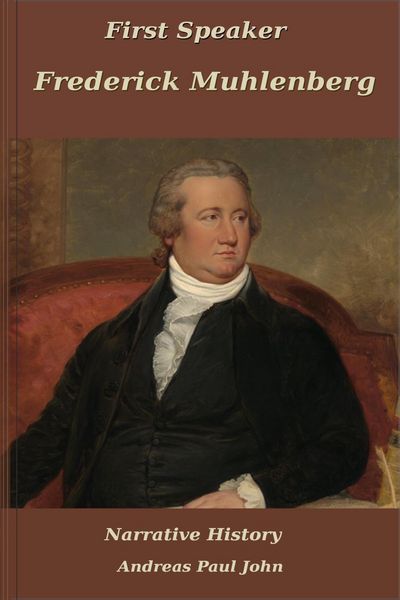
First Speaker Frederick Muhlenberg
-
- Einzelkauf Download ausgewählt
-
Sprache:Englisch
Fr. 4.00
inkl. gesetzl. MwSt.Beschreibung
Produktdetails
Format
ePUB
Kopierschutz
Ja
Family Sharing
Ja
Text-to-Speech
Ja
Erscheinungsdatum
31.05.2026
Verlag
Andreas Paul JohnSeitenzahl
(Printausgabe)
Dateigröße
15848 KB
Sprache
Englisch
EAN
9798235797437
First Speaker: Frederick Mühlenberg. The story of a man America has half-forgotten and Germany never knew.n the new country and why a pastor's son from Pennsylvania stepped before the House of Representatives on April 1, 1789, as its first presiding officer.
On July 4, 2026, the Declaration of Independence turns 250. This book is published on that day about the generation that turned the Declaration into a state.
The Declaration of 1776 was a manifesto: a text, not a state. What happened between 1776 and 1789 was the slow work of turning a manifesto into a constitution, a constitution into a Congress, and a Congress into a functioning republic. That work did not fall to the signers. It fell to the next generation those who in 1776 were too young to sign, and in 1789 old enough to write the rules of procedure.
Frederick Muhlenberg was one of them. On April 1, 1789, thirteen years after the Declaration, he stood before the House of Representatives as its first Speaker and opened the session. The Bill of Rights passed through his hands.
He is a footnote of the founding era his portrait hangs in the Capitol, his name appears in every history of the First Congress. But the full arc of his life has rarely been told as a single story: from the baptism at Trappe in January 1750, with his grandfather Conrad Weiser at the table; through seven years of schooling at the Francke Foundations in Halle; the return to a country waiting for war; the parsonage during the Revolution; fifteen years of politics in Pennsylvania and the new Congress; the one vote for the Jay Treaty in 1796 that saved the treaty and ended his career; to his death in Lancaster on June 4, 1801.
It is also the story of a family that did, across three generations, what immigrants are for: arrive, serve, be forgotten. Conrad Weiser, the grandfather. Henry Melchior Muhlenberg, the father. Frederick, the son. Three men, three languages, one country becoming itself.
Written in the form colonial history should be told close to the sources, no invented dialogue, no pathos. What is documented stands as documented. What is not, is marked as such.
Noch keine Bewertungen vorhanden
Verfassen Sie die erste Bewertung zu diesem Artikel
Helfen Sie anderen Kundinnen und Kunden durch Ihre Meinung.