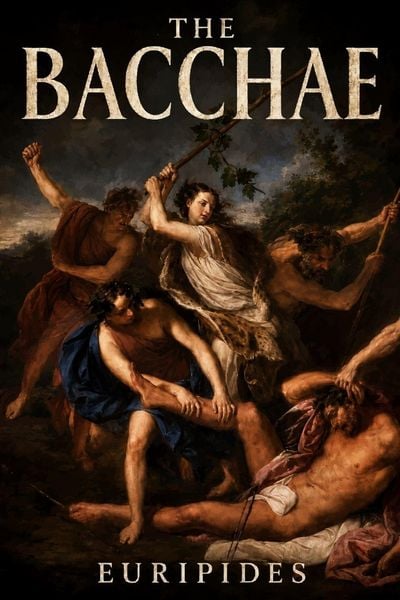
The Bacchae A New Translation of the Classic Greek Tragedy
-
- Englisch ausgewählt
Fr. 15.90
inkl. gesetzl. MwSt.,
-
Kostenlose Lieferung ab Fr. 30 Einkaufswert
Schweiz & Liechtenstein:
Versandkostenfrei ab Fr. 30.00
Versandkosten bis Fr. 30.00: Fr. 3.50Andere Lieferländer
Fr. 18.00 unabhängig vom Warenwert
Beschreibung
Produktdetails
Einband
Taschenbuch
Erscheinungsdatum
24.07.2026
Verlag
Amazon Digital Services LLC - KdpSeitenzahl
78
Maße (L/B/H)
22.9/15.2/0.4 cm
Gewicht
118 g
Übersetzt von
Hazel Evermore
Sprache
Englisch
ISBN
978-1-918966-65-7
The Bacchae by Euripides was the last play he ever wrote. Euripides was in his late seventies when he composed it, living at the court of King Archelaus of Macedon, and he died before he could see it staged. His son or nephew presented the play at the Great Dionysia in Athens around 405 BCE, some months after his death. It won first prize. It is among the strangest and most enduring of all Greek tragedies.
The story concerns the arrival of the god Dionysus in the Greek city of Thebes, where he has come to establish his worship. Dionysus is the son of Zeus and the Theban princess Semele - his mother had died before his birth, and Dionysus has come home to answer those of her family who had denied his divinity. His cousin Pentheus, the young king of Thebes, is one of the deniers. When the play opens, the women of Thebes, including Pentheus's own mother Agave and his aunts, have already fallen under Dionysus's power and are gathered on the slopes of Mount Cithaeron, dressed in fawn skins, dancing and singing in the god's rites. Pentheus, disturbed and fascinated, tries to suppress the new god's worship. What follows is one of the most powerful sequences in Greek literature.
The play is a study of what happens when a rigid, rationalising order refuses to acknowledge the older and stranger forces beneath it. Pentheus is not a bad man. He is a young king trying to maintain civic order. Dionysus is not exactly evil - he is the god of wine, of music and dance, of the wild in nature and the wild in the human mind. Euripides refuses to condemn either side and refuses to reconcile them. The play insists that both are real, both are necessary, and what happens when a society tries to suppress one of them is what happens in the second half of The Bacchae.
Modern readers have found in the play almost everything they have looked for - a psychological drama about the divided self, a political meditation on the limits of state power, a religious study of the sacred and the terrible, and a proto-modernist exploration of forces that will not stay buried. What is beyond dispute is that The Bacchae stands at the outer edge of what Greek tragedy attempted, and that no other play from the ancient world quite matches its combination of formal beauty, mythological strangeness, and moral seriousness.
The Bacchae has had an outsized influence on the modern literary imagination. Friedrich Nietzsche took its central conflict as the starting point of The Birth of Tragedy. It continues to be staged more often than almost any Greek play except the Theban dramas of Sophocles, and it stands as one of the essential plays of the Western dramatic tradition.
This edition is a new English translation from the Greek by Hazel Evermore, working directly from the original text. The translation aims to preserve the compressed intensity and formal control of Euripidean verse while making the play immediately available to the English-language reader.
A short, essential classic of the Western dramatic tradition, in a new English translation.
Available in Kindle, Paperback, and Hardcover.
Noch keine Bewertungen vorhanden
Verfassen Sie die erste Bewertung zu diesem Artikel
Helfen Sie anderen Kundinnen und Kunden durch Ihre Meinung.