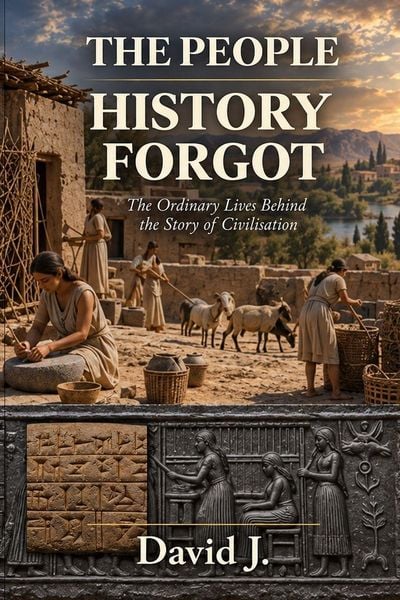
The People History Forgot The Ordinary Lives Behind the Story of Civilisation
-
- Englisch ausgewählt
Fr. 19.90
inkl. gesetzl. MwSt.,
-
Kostenlose Lieferung ab Fr. 30 Einkaufswert
Schweiz & Liechtenstein:
Versandkostenfrei ab Fr. 30.00
Versandkosten bis Fr. 30.00: Fr. 3.50Andere Lieferländer
Fr. 18.00 unabhängig vom Warenwert
Beschreibung
Produktdetails
Einband
Taschenbuch
Erscheinungsdatum
19.09.2026
Verlag
Independently PublishedSeitenzahl
72
Maße (L/B/H)
22.9/15.2/0.4 cm
Gewicht
111 g
Sprache
Englisch
EAN
9798175453578
History remembers kings, conquerors, battles and monuments.
But behind every civilisation were millions of ordinary people whose names have disappeared.
The People History Forgot turns away from palaces and rulers to look at the lives that usually remain in the background: farmers, workers, women, children, sailors, soldiers, craftspeople, enslaved people and families simply trying to make a life.
Through footprints preserved in ancient ground, fingerprints in clay, worn tools, household objects, tablets, letters, burials and photographs, David J. explores what archaeology and surviving evidence can still tell us about people who were never expecting history to remember them.
A footprint may show someone carrying a child. A school exercise can preserve a student's mistake. A broken object can reveal years of work, repair and use. Small traces can bring us unexpectedly close to people separated from us by centuries or even thousands of years.
The book never pretends that the evidence tells us more than it does. Where a life cannot be reconstructed, the uncertainty remains. Yet absence does not mean insignificance.
The evidence may be small. The life was not.
Quiet, compassionate and grounded in historical evidence, The People History Forgot is a reminder that civilisation was not built only by the people whose names survived.
It was built by everybody else.
Noch keine Bewertungen vorhanden
Verfassen Sie die erste Bewertung zu diesem Artikel
Helfen Sie anderen Kundinnen und Kunden durch Ihre Meinung.