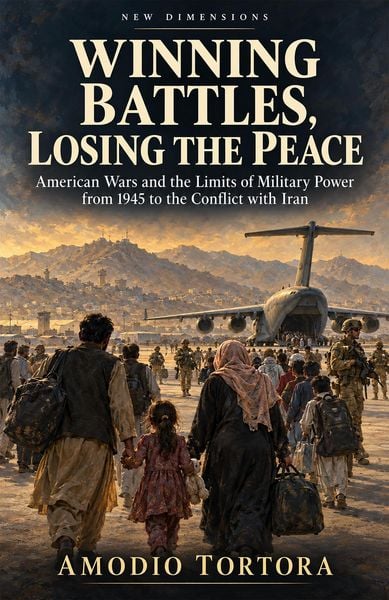
Winning Battles, Losing the Peace New Dimensions
-
- Einzelkauf Download ausgewählt
-
Sprache:Englisch
Fr. 3.50
inkl. gesetzl. MwSt.Beschreibung
Produktdetails
Format
ePUB
Kopierschutz
Ja
Family Sharing
Ja
Text-to-Speech
Ja
Erscheinungsdatum
14.10.2026
Verlag
Self-PublishingSeitenzahl
(Printausgabe)
Dateigröße
344 KB
Sprache
Englisch
EAN
9798237958102
Unpublished work - First edition: Year 2026.
Winning Battles, Losing the Peace examines a persistent problem in American political and military history: the inability to convert military superiority into durable political outcomes. Across twelve chapters, it traces the distance between defeating an adversary and establishing a sustainable peace, asking how victories on the battlefield can lead to strategic disappointment, prolonged dependency, and consequences that outlast the fighting.
Beginning with the legacy of 1945, the book explores how the defeat of Germany and Japan shaped expectations that force could remove hostile governments and create stable partners. It reconstructs the exceptional conditions behind those achievements and considers the dangers of applying their lessons to limited wars, insurgencies, and societies divided over legitimate authority. Victory emerges as a judgment requiring comparison among objectives, results, costs, and the endurance of the order produced.
Korea and Vietnam reveal different limits of American power. The preservation of South Korea demonstrates the value of an incomplete but meaningful defensive outcome, while the pursuit of reunification exposes the risks of expanding objectives. Vietnam illustrates how attrition, firepower, and numerical indicators could coexist with political weakness and eventual defeat. The analysis also examines Grenada, Panama, Kuwait, and the Balkans, recognizing successes that complicate any claim that the United States invariably loses its wars.
Iraq and Afghanistan form the central studies of the failure to build sustainable political orders. In Iraq, the rapid overthrow of Saddam Hussein opened a struggle over security, institutions, representation, and regional influence. In Afghanistan, years of assistance produced social gains while sustaining institutions dependent on foreign finance, logistics, and protection. Their collapse exposes the difference between supporting a government and creating the conditions for its survival.
The wider war on terrorism raises a problem: how to conclude a military undertaking directed against a recurring method of violence. The book distinguishes the disruption of organizations and the defeat of territorial rule from the unattainable promise of eliminating every future threat. It investigates how presidential credibility, congressional incentives, military reporting, intelligence assessments, contracting, and public communication can prolong commitments even when their purposes become doubtful.
Attention then shifts to the costs that remain after major combat ends. Death, disability, psychological injury, displacement, damaged services, debt, and environmental hazards reveal why withdrawal cannot be equated with the disappearance of responsibility. The unequal burdens borne by American personnel and civilian populations require an assessment extending beyond operational expenditure and official declarations of success.
A special chapter considers Iran through a provisional framework rather than a predetermined verdict. It examines the relationship between destructive capacity, nuclear constraints, maritime security, regional retaliation, and negotiated outcomes. The conclusion brings these comparisons together to define strategy as the selection of attainable purposes and sustainable obligations. The book argues that military power becomes effective when leaders understand the political order they seek, the institutions needed to maintain it, and the costs they are prepared to bear. Its guiding concern is whether the peace pursued can survive the means used to obtain it.
Noch keine Bewertungen vorhanden
Verfassen Sie die erste Bewertung zu diesem Artikel
Helfen Sie anderen Kundinnen und Kunden durch Ihre Meinung.