KI-Beratung Beta

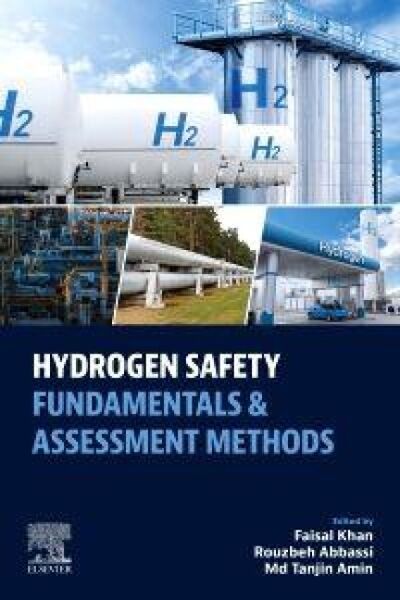
Produktbild: Hydrogen Safety Fundamentals and Assessment Methods
Vorbesteller Neu

Hydrogen Safety Fundamentals and Assessment Methods

Fr. 197.00

inkl. gesetzl. MwSt., Versandkostenfrei


Beschreibung

Hydrogen Safety Fundamentals & Assessment Methods is an essential guide to understanding and managing the safety challenges associated with hydrogen as a clean energy source. As the world shifts toward sustainable energy solutions, hydrogen is becoming increasingly important across transportation, industry,...

Beschreibung

Hydrogen Safety Fundamentals & Assessment Methods is an essential guide to understanding and managing the safety challenges associated with hydrogen as a clean energy source. As the world shifts toward sustainable energy solutions, hydrogen is becoming increasingly important across transportation, industry, and power generation. However, its high flammability, rapid diffusion, and interactions with materials pose significant safety risks.
This book combines the latest scientific research with practical safety practices, making complex topics accessible to researchers, engineers, policymakers, and industry professionals. It covers hydrogen's physical and chemical properties, leak detection and management, dispersion modeling, fire and explosion hazards, and material impacts. Its structured progression moves from fundamental concepts through specific hazard phenomena to system-level safety considerations across the value chain, with an in-depth chapter on advanced risk assessment methods serving as both a foundational reference and a guide to state-of-the-art practices.
The book covers safety considerations during hydrogen production, transportation, and usage, featuring risk assessment methods such as fault tree analysis, Bayesian networks, and AI-based approaches, alongside cyber-physical security aspects relevant to hydrogen infrastructure. Real-world case studies and current experimental data support safe hydrogen deployment across research, engineering, policy development, and industrial applications, helping bridge critical knowledge gaps in the field.

Portrait

Faisal Khan is a Chemical Engineering Professor and Director of the Mary Kay O'Connor Process Safety Center and the Ocean Energy Safety Institute (OESI), Texas A&M University. He is the founder of the Centre for Risk Integrity and Safety Engineering (C-RISE), a Fellow of the Canadian Academy of Engineering, the Engineering Institute of Canada, and the Canadian Society of Chemical Engineering. His areas of research interest include offshore safety and risk engineering, inherent safety, risk management, and risk-based integrity assessment and management. Dr. Khan is actively involved with multinational oil and gas industries in addressing safety and asset integrity issues. He also served as the Safety and Risk Advisor to the Government of Newfoundland and Labrador, Canada. He continues to serve as a subject matter expert to many organizations, including Lloyd's Register EMEA, SBM Modco, Intecsea, Technip, and Qatar Gas. He served as a Visiting Professor of Offshore and Marine Engineering at the Australian Maritime College (AMC), University of Tasmania, Australia, where he led the development of the offshore safety and risk engineering group and initiated global engagements with numerous international institutions.

Dr. Khan is the recipient of the President's Outstanding Research Award of 2012–13 at Memorial University, the President's Outstanding Research Supervision Award of 2013–14 at Memorial University, the CSChE National Award on Process Safety Management of 2014, and the Society of Petroleum Engineers award for his contribution to Health, Safety, and Risk Engineering. He has authored over 500 research articles in peer-reviewed journals and conferences on safety, risk, and reliability engineering. He has authored five books on the subject area. He is the Editor of the Journal of Process Safety and Environmental Protection, Safety in Extreme Environment, and ASME Part A (Risk and Uncertainty Analysis). He regularly offers training programs/workshops on safety and risk engineering in various locations, including St. John's, Chennai, Dubai, Beijing, Aberdeen, Cape Town, Doha, and Kuala Lumpur.

Rouzbeh Abbassi is a Professor of Risk and Safety Engineering in the Artie McFerrin Department of Chemical Engineering at Texas A&M University. His research focuses on safety and risk engineering for complex energy and process systems, with particular emphasis on dynamic risk assessment, asset integrity, and emerging energy technologies. He has led and contributed to major national and international research initiatives, authored and edited several books, holds editorial roles with leading journals, and has collaborated with various industry partners on the safety, reliability, and resilience of engineering systems

Dr. Md Tanjin Amin is a Lecturer in the Department of Chemical and Environmental Engineering, RMIT University. He is an Editor in the Process Safety and Environmental Protection journal. His research focuses on fault diagnosis, process monitoring, safety and risk engineering, and offshore hydrogen production systems. He has co-authored 40+ high-impact papers on these topics. He has received multiple awards for his research contribution and editorial role.
Produktdetails

Einband

Taschenbuch

Erscheinungsdatum

01.04.2027

Herausgeber Faisal Khan + weitere
Verlag Elsevier

Produktdetails

Einband

Taschenbuch

Erscheinungsdatum

01.04.2027

Herausgeber
Verlag Elsevier
Seitenzahl

400

Maße (L/B)

22.9/15.2 cm

Gewicht

449 g

Sprache

Englisch

ISBN

978-0-443-48505-3

Herstelleradresse

Libri GmbH
Europaallee 1
36244 Bad Hersfeld
DE

Email: gpsr@libri.de

Noch keine Bewertungen vorhanden

Verfassen Sie die erste Bewertung zu diesem Artikel

Helfen Sie anderen Kundinnen und Kunden durch Ihre Meinung.

Kundinnen und Kunden meinen

Bewertungen (0)

  • Produktbild: Hydrogen Safety Fundamentals and Assessment Methods
  • 1. Properties and boundary limits on hydrogen use
    2. Hydrogen leak identification, assessment, and management
    3. Hydrogen dispersion modeling methods
    4. Hydrogen fire assessment and management
    5. Hydrogen explosion types and their assessment and management
    6. Hydrogen’s impact on metals and materials
    7. Hydrogen production safety
    8. Hydrogen transportation safety
    9. Safety of hydrogen as a fuel
    10. Hydrogen risk assessment methods
    11. Cyber-physical security of hydrogen systems