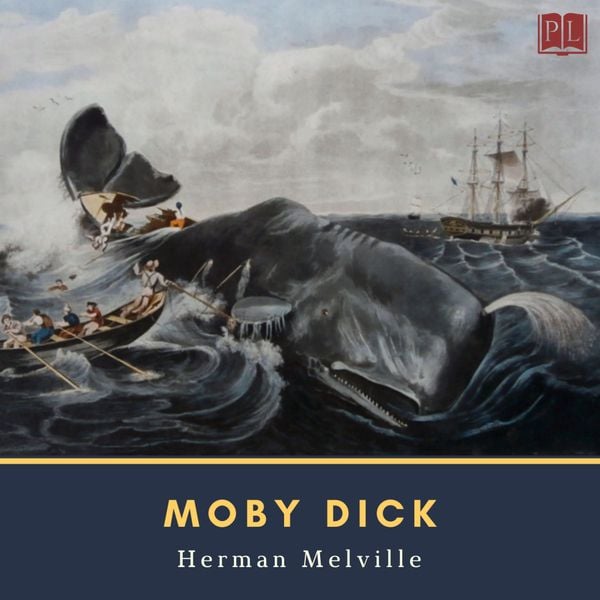

Moby Dick
Gesprochen von
4
-
- Hardcover
- Taschenbuch
- eBook
- Hörbuch ausgewählt
-
Form:Orell Füssli Hörbuch-Abo
-
Hörtyp:Lesung
- Hörspiel Fr. 4.40
- Lesung ausgewählt
-
Hörbuchfassung:ungekürzt
- gekürzt Fr. 14.90
- ungekürzt ausgewählt
-
Sprache:Englisch
-
Gesprochen von:Stewart Wills
Fr. 0.00 *
inkl. gesetzl. MwSt.
* im Probemonat gratis danach Fr. 12.90/Monat
* im Probemonat gratis danach Fr. 12.90/Monat
Im Hörbuch-Abo laden
- Monatlich einen Titel wählen & behalten
- Jederzeit pausieren oder kündigen
- Weitere Hörbücher im Abo für max. Fr. 12.90
Beschreibung
Produktdetails
Family Sharing
Ja
Gesprochen von
Stewart WillsSpieldauer
24 Stunden und 14 Minuten
Abo-Fähigkeit
Ja
Erscheinungsdatum
01.01.2021
Hörtyp
Lesung
Fassung
ungekürzt
Medium
MP3
Anzahl Dateien
140
Verlag
Parolita LibroSprache
Englisch
EAN
4064066883133
Moby-Dick; or, The Whale is an 1851 novel by American writer Herman Melville. The book is the sailor Ishmael's narrative of the obsessive quest of Ahab, captain of the whaling ship Pequod, for revenge on Moby Dick, the giant white sperm whale that on the ship's previous voyage bit off Ahab's leg at the knee. A contribution to the literature of the American Renaissance, Moby-Dick was published to mixed reviews, was a commercial failure, and was out of print at the time of the author's death in 1891. Its reputation as a Great American Novel was established only in the 20th century, after the centennial of its author's birth. William Faulkner said he wished he had written the book himself, and D. H. Lawrence called it "one of the strangest and most wonderful books in the world" and "the greatest book of the sea ever written". Its opening sentence, "Call me Ishmael", is among world literature's most famous.
Melville began writing Moby-Dick in February 1850, and finished 18 months later, a year longer than he had anticipated. Melville drew on his experience as a common sailor from 1841 to 1844, including several years on whalers, and on wide reading in whaling literature. The white whale is modeled on the notoriously hard-to-catch albino whale Mocha Dick, and the book's ending is based on the sinking of the whaleship Essex in 1820. His literary influences include Shakespeare and the Bible. The detailed and realistic descriptions of whale hunting and of extracting whale oil, as well as life aboard ship among a culturally diverse crew, are mixed with exploration of class and social status, good and evil, and the existence of God. In addition to narrative prose, Melville uses styles and literary devices ranging from songs, poetry, and catalogs to Shakespearean stage directions, soliloquies, and asides. In August 1850, with the manuscript perhaps half finished, he met Nathaniel Hawthorne and was deeply moved by his Mosses from an Old Manse, which he compared to Shakespeare in its cosmic ambitions. This encounter may have inspired him to revise and expand Moby-Dick, which is dedicated to Hawthorne, "in token of my admiration for his genius".
The book was first published (in three volumes) as The Whale in London in October 1851, and under its definitive title in a single-volume edition in New York in November. The London publisher, Richard Bentley, censored or changed sensitive passages; Melville made revisions as well, including a last-minute change to the title for the New York edition. The whale, however, appears in the text of both editions as Moby Dick, without the hyphen. Reviewers in Britain were largely favorable, though some objected that the tale seemed to be told by a narrator who perished with the ship, as the British edition lacked the Epilogue recounting Ishmael's survival. American reviewers were more hostile. About 3,200 copies of the book were sold during the author's life.
Melville began writing Moby-Dick in February 1850, and finished 18 months later, a year longer than he had anticipated. Melville drew on his experience as a common sailor from 1841 to 1844, including several years on whalers, and on wide reading in whaling literature. The white whale is modeled on the notoriously hard-to-catch albino whale Mocha Dick, and the book's ending is based on the sinking of the whaleship Essex in 1820. His literary influences include Shakespeare and the Bible. The detailed and realistic descriptions of whale hunting and of extracting whale oil, as well as life aboard ship among a culturally diverse crew, are mixed with exploration of class and social status, good and evil, and the existence of God. In addition to narrative prose, Melville uses styles and literary devices ranging from songs, poetry, and catalogs to Shakespearean stage directions, soliloquies, and asides. In August 1850, with the manuscript perhaps half finished, he met Nathaniel Hawthorne and was deeply moved by his Mosses from an Old Manse, which he compared to Shakespeare in its cosmic ambitions. This encounter may have inspired him to revise and expand Moby-Dick, which is dedicated to Hawthorne, "in token of my admiration for his genius".
The book was first published (in three volumes) as The Whale in London in October 1851, and under its definitive title in a single-volume edition in New York in November. The London publisher, Richard Bentley, censored or changed sensitive passages; Melville made revisions as well, including a last-minute change to the title for the New York edition. The whale, however, appears in the text of both editions as Moby Dick, without the hyphen. Reviewers in Britain were largely favorable, though some objected that the tale seemed to be told by a narrator who perished with the ship, as the British edition lacked the Epilogue recounting Ishmael's survival. American reviewers were more hostile. About 3,200 copies of the book were sold during the author's life.