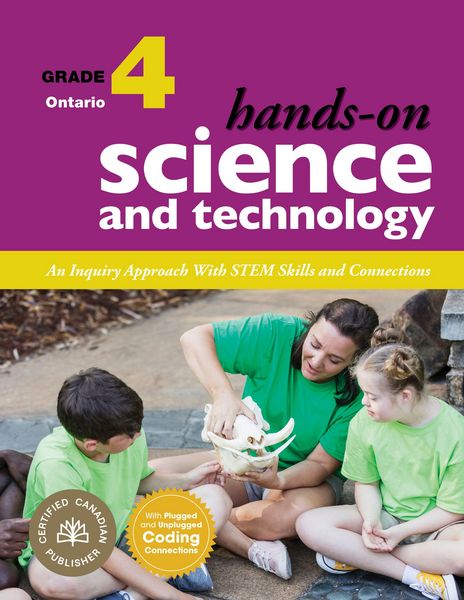
Produktbild: Hands-On Science and Technology for Ontario, Grade 4

Hands-On Science and Technology for Ontario, Grade 4 An Inquiry Approach with Stem Skills and Connections

Fr. 188.00

inkl. gesetzl. MwSt., Versandkostenfrei


Produktdetails

Einband

Taschenbuch

Erscheinungsdatum

21.01.2025

Verlag

Portage & Main Press

Seitenzahl

336

Maße (L/B/H)

27.9/23.6/2.8 cm

Gewicht

975 g

Sprache

Englisch

ISBN

978-1-77492-069-5

Produktdetails

Einband

Taschenbuch

Erscheinungsdatum

21.01.2025

Verlag

Portage & Main Press

Seitenzahl

336

Maße (L/B/H)

27.9/23.6/2.8 cm

Gewicht

975 g

Sprache

Englisch

ISBN

978-1-77492-069-5

Herstelleradresse

Libri GmbH
Europaallee 1
36244 Bad Hersfeld
DE

Email: gpsr@libri.de

Kundinnen und Kunden meinen

0 Bewertungen

Informationen zu Bewertungen

Zur Abgabe einer Bewertung ist eine Anmeldung im Konto notwendig. Die Authentizität der Bewertungen wird von uns nicht überprüft. Wir behalten uns vor, Bewertungstexte, die unseren Richtlinien widersprechen, entsprechend zu kürzen oder zu löschen.

Die Bewertungen sind nach Format, Anzahl Sterne und Datum sortiert.

Verfassen Sie die erste Bewertung zu diesem Artikel

Helfen Sie anderen Kund*innen durch Ihre Meinung

Kundinnen und Kunden meinen

0 Bewertungen filtern

Weitere Artikel finden Sie in

  • Produktbild: Hands-On Science and Technology for Ontario, Grade 4
  • Introduction to Hands-On Science and Technology for Ontario, Grade 4

    • Introduction to Hands-On Science and Technology 2
    • Program Introduction 2
    • The Inquiry Approach to Science and Technology 2
    • 21st Century Teaching and Learning 3
    • The Goals of the Science and Technology Program 3
    • Hands-On Science and Technology Strands and Expectations 4
    • Hands-On Science and Technology Fundamental Concepts and Big Ideas 4
    • Hands-On Science and Technology Program Principles 4
    • Infusing Indigenous Perspectives 5
    • Cultural Connections 6
    • Land-Based Learning 7
    • Technology 7
    • Sustainability 7
    • Program Implementation 7
    • Program Resources 7
    • Classroom Environment 11
    • Planning Units--Timelines 11
    • Classroom Management 11
    • Classroom Safety 12
    • Scientific Inquiry Skills: Guidelines for Teachers 12
    • Observing 12
    • Questioning 12
    • Exploring 12
    • Classifying 13
    • Measuring 13
    • Communicating, Analyzing, and Interpreting 13
    • Predicting 15
    • Inferring 15
    • Inquiry Through Investigation and Experiments 16
    • Inquiry Through Research 16
    • Online Considerations 17
    • Addressing Students' Literacy Needs 17
    • Technological Problem Solving 17
    • Makerspace 18

    The Hands-On Science and Technology Assessment Plan 20

    • Assessment for Learning 21
    • Assessment as Learning 21
    • Assessment of Learning 22
    • Performance Assessment 23
    • Portfolios 23
    • Evidence of Student Achievement Levels for Evaluation 24
    • Important Note to Teachers 24
    • References 25
    • Assessment Reproducibles 26
    • Achievement Chart for Science & Technology 41

    Unit 1: Habitats and Communities 43

    • Introduction 44
    • Unit Overview 48
    • Curriculum Correlation 49
    • Resources for Students 51
      • 1 What Do We Know About Habitats and Communities? 55
      • 2 Why Do Plants and Animals Live in Certain Habitats? 63
      • 3 Which Organisms Are Found in Our Local Habitats? 68
      • 4 How Can We Measure Populations in a Habitat? 74
      • 5 How Do Plants and Animals Adapt to Survive in Their Environment? 79
      • 6 What Relationships Occur Between Populations Within a Community? 86
      • 7 What Are the Characteristics of Herbivores, Carnivores, and Omnivores? 91
      • 8 What Are the Relationships Between Predators, Prey, and Scavengers? 96
      • 9 What Are the Characteristics of Producers, Consumers, and Decomposers? 100
      • 10 What Is a Food Chain? 106
      • 11 What Is a Food Web? 111
      • 12 How Are Plants and Animals Important to Humans and to the Environment? 115
      • 13 How Can We Create Living Habitats? 120
      • 14 What Are Some Natural and Human Impacts on Organisms in the Environment? 123
      • 15 Inquiry Project: What Can I Do to Protect Habitats and Communities? 128

      Unit 2: Pulleys and Gears 133

      • Introduction 134
      • Unit Overview 138
      • Curriculum Correlation 139
      • Resources for Students 140
        • 1 What Do We Know About Forces and Machines? 143
        • 2 How Do Wheels and Axles Work? 148
        • 3 How Do Gears Help Make Work Easier? 154
        • 4 What Can We Learn About Gears and Direction of Movement? 159
        • 5 How Can We Design and Construct Devices With Working Gears? 165
        • 6 How Does a Single-Fixed Pulley Make Work Easier? 168
        • 7 How Do Movable and Compound Pulleys Make Work Easier? 173
        • 8 How Can We Design and Construct a Working Pulley System? 180
        • 9 What Are the Advantages and Disadvantages of Using Machines With Pulleys and Gears? 184
        • 10 Inquiry Project: How Can We Design and Build a System of Pulleys and Gears for a Specific Purpose? 188

        Unit 3: Light and Sound 191

        • Introduction 192
        • Unit Overview 197
        • Curriculum Correlation 198
        • Resources for Students 199
          • 1 What Do We Know About Light? 203
          • 2 How Does Light Travel? 208
          • 3 How Does Light Reflect? 213
          • 4 How Well Does Light Pass Through Different Materials? 218
          • 5 How Can We See Light&rsquo s Many Colours? 222
          • 6 How Has Light Technology Changed Over Time? 226
          • 7 Inquiry Project: How Can I Design and Construct an Optical Device to Transmit and Reflect Light? 230
          • 8 What Do We Want to Learn About Sound? 234
          • 9 How Is Sound Created? 239
          • 10 What Is Pitch? 244
          • 11 How Do Sound Waves Travel? 249
          • 12 Which Materials Are Insulators or Conductors of Sound? 253
          • 13 How Can We Amplify Sound? 257
          • 14 How Do We Hear Sound, and How Can We Protect Our Sense of Hearing? 261
          • 15 How Do Musical Instruments Use Sound Energy? 267
          • 16 How Can We Design and Construct Musical Instruments Using Various Materials? 272
          • 17 Inquiry Project: What Can We Learn About Sound Technology? 278

          Unit 4: Rocks and Minerals 281

          • Introduction 282
          • Unit Overview 285
          • Curriculum Correlation 286
          • Resources for Students 287
            • 1 What Do We Know About Rocks and Minerals? 289
            • 2 How Can We Compare and Classify Rocks and Minerals? 295
            • 3 How Can Minerals Be Classified? 299
            • 4 How Are Different Types of Rock Formed? 304
            • 5 What Are Some Uses for Rocks and Minerals? 313
            • 6 How Are Fossils Formed? 319
            • 7 Inquiry Project: How Are Rocks and Minerals Mined From the Earth? 324
            • 8 How Does Mining Impact Habitats and Communities? 327
          • References 332
          • Appendix: Image Banks 333

            About the Contributors 342