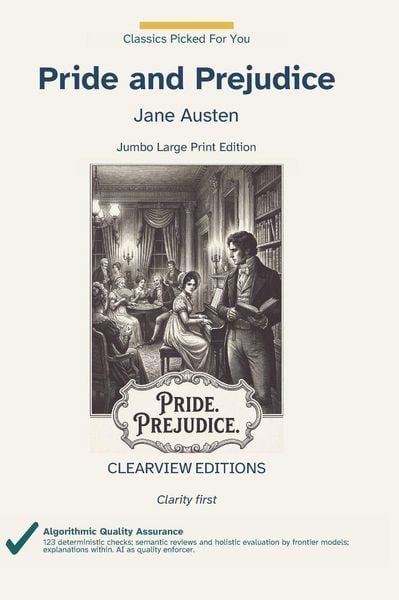
Pride and Prejudice A Clearview Large Print Edition
-
- Hardcover ausgewählt
- Taschenbuch
- Besondere Ausgabe
- eBook
- Hörbuch
- Leder
- Sonstiges
-
Sprache:Englisch
-
Verlag:W. Frederick Zimmerman
- Anaconda Fr. 22.90
- Insel Verlag Fr. 22.90
- Random House N.Y. Fr. 26.90
- Pearson ELT Fr. 16.90
- Random House USA Fr. 25.90
- Penguin LLC US Fr. 24.90
- Quarto Publishing Group Fr. 16.90
- Nikol Fr. 15.90
- Carlton Publishing Fr. 26.90
- Flame Tree Fr. 19.90
- Hinkler Books Fr. 17.90
- Arcturus Publishing Ltd Fr. 18.90
- SaltWay Fr. 14.90
- Pan Macmillan Fr. 19.90
- Everyman's Library Hardback Fr. 20.90
- Macmillan Fr. 19.90
- Wordsworth Editions Ltd Fr. 15.90
- Ashridge Publishing Fr. 19.90
- W. Frederick Zimmerman Fr. 105.00 ausgewählt
- Penguin Books Ltd Fr. 23.90
Fr. 105.00
inkl. gesetzl. MwSt.,
Beschreibung
Produktdetails
Einband
Gebundene Ausgabe
Erscheinungsdatum
26.09.2026
Verlag
W. Frederick ZimmermanSeitenzahl
924
Maße (L/B/H)
25.4/17.8/4.8 cm
Gewicht
1801 g
Sprache
Englisch
ISBN
978-1-60888-821-4
Jane Austen's Pride and Prejudice begins with the arrival of a wealthy new neighbor and the expectations his arrival awakens in the Bennet household. Mr. and Mrs. Bennet have five unmarried daughters, and the family's future is shaped by money, property, social connections, and the limits placed on women's choices. Charles Bingley's interest in Jane Bennet seems to offer an agreeable prospect. His friend Fitzwilliam Darcy makes a less welcome impression on Elizabeth, whose quick judgment of his manners helps set the novel's central relationship in motion.
Elizabeth Bennet is an observant and lively participant in the social world around her. She enjoys absurdity, resists pressure, and values affection and respect. Yet her confidence in her own observations does not always protect her from error. Darcy likewise has to confront the effect of his conduct and the assumptions behind it. Their changing understanding develops through conversations, visits, letters, unexpected encounters, and the consequences of actions neither initially understands in full. Austen allows attraction and resistance to grow alongside a demanding reconsideration of character.
The story extends well beyond its central pair. Jane and Bingley, Charlotte Lucas and Mr. Collins, Lydia Bennet and George Wickham offer sharply different relationships between affection, advantage, security, and judgment. Mrs. Bennet's urgency, Mr. Bennet's retreat into amusement, Lady Catherine de Bourgh's authority, and the Gardiners' steadier support all influence the daughters' choices. Austen makes these people more than examples in a marriage plot. Their habits of speech, their use of hospitality, their treatment of relatives, and their response to embarrassment continually disclose who they are.
The novel moves through the Bennets' home at Longbourn, the neighboring society of Meryton and Netherfield, the households at Hunsford and Rosings, London, and the visit to Pemberley. Each setting changes what Elizabeth can see and what she thinks she knows. A ballroom offers one kind of evidence, a letter another, and the testimony of someone outside a familiar circle another still. The plot repeatedly asks how a reputation is formed, how a persuasive story can mislead, and what it takes to revise an opinion that has become satisfying to hold.
Austen's comedy depends on close attention to language. Polite exchanges carry concealed disagreements; invitations, proposals, compliments, and refusals reveal differences of power and expectation. The narrator's irony moves between sympathy and exposure without losing sight of the practical stakes. Marriage can affect a person's home, income, standing, freedom, and obligations to family. The result is a novel in which the pleasures of wit and courtship remain inseparable from questions of responsibility, self-knowledge, and the possibility of making a better judgment.
This Clearview Editions volume presents the complete novel in large print, preserving Austen's narrative and dialogue rather than replacing them with a retelling. Publisher-created notes identify the retained source text and explain the preparation of the edition. The work was first published in 1813. The reading experience follows Elizabeth's changing view of the people around her while keeping the full social world of the Bennets, their friends, their relations, and their neighbors in view.
The 7 by 10 inch casebound format uses 18-point Atkinson Hyperlegible Next type with 27-point line spacing. Ragged-right paragraphs and line endings without automatic word division provide a spacious, consistent page. Contents and chapter navigation support reading in stages or returning to a particular exchange. The edition is intended for readers who want Austen's complete prose in large type, including the small verbal turns and changing perspectives on which her comedy and her characters depend.
Kundinnen und Kunden meinen
Unsere Meinungen
-
Zum Bewerterprofil von Amanda Blumer

Amanda Blumer
Orell Füssli Regensdorf – EKZ Zentrum
Buchhändler*in
Es ist ein Problem aufgetreten. Bitte laden Sie die Seite neu und versuchen es noch einmal.
Buch (Taschenbuch)
Eine der ersten Liebesgeschichten, die ich gerne gelesen habe.
Elizabeth lernt den Mr. Darcy auf einem Tanz kennen. Sie sind sich gegenseitig nicht wirklich sympathisch. Dies vor allem aufgrund von Stolz und Vorurteilen. Die beiden sind sehr selbstbestimmte Charaktere und finden auf wundersame Weise doch zueinander. Der Roman gibt einen tiefen Einblick in die Familie der Bennets. Dabei war mir Elizabeth besonders sympathisch. Sie ist willensstark und wirkt so selbstbewusst! Obwohl das Ganze in einer Zeit stattfindet, in der diese Charaktereigenschaften bei einer Frau alles andere als erwünscht und die Norm sind. Nicht zu vergessen, dass die Geschichte auch in einer Zeit geschrieben wurde, in der diese Handlung sehr ungewöhnlich ist, weshalb Austen auch unter einem Pseudonym schreiben musste. Das Schreiben der Autorin ist seiner Zeit absolut voraus. Ich bin von diesem Roman nachhaltig beeindruckt!